Research
Check out my new book!
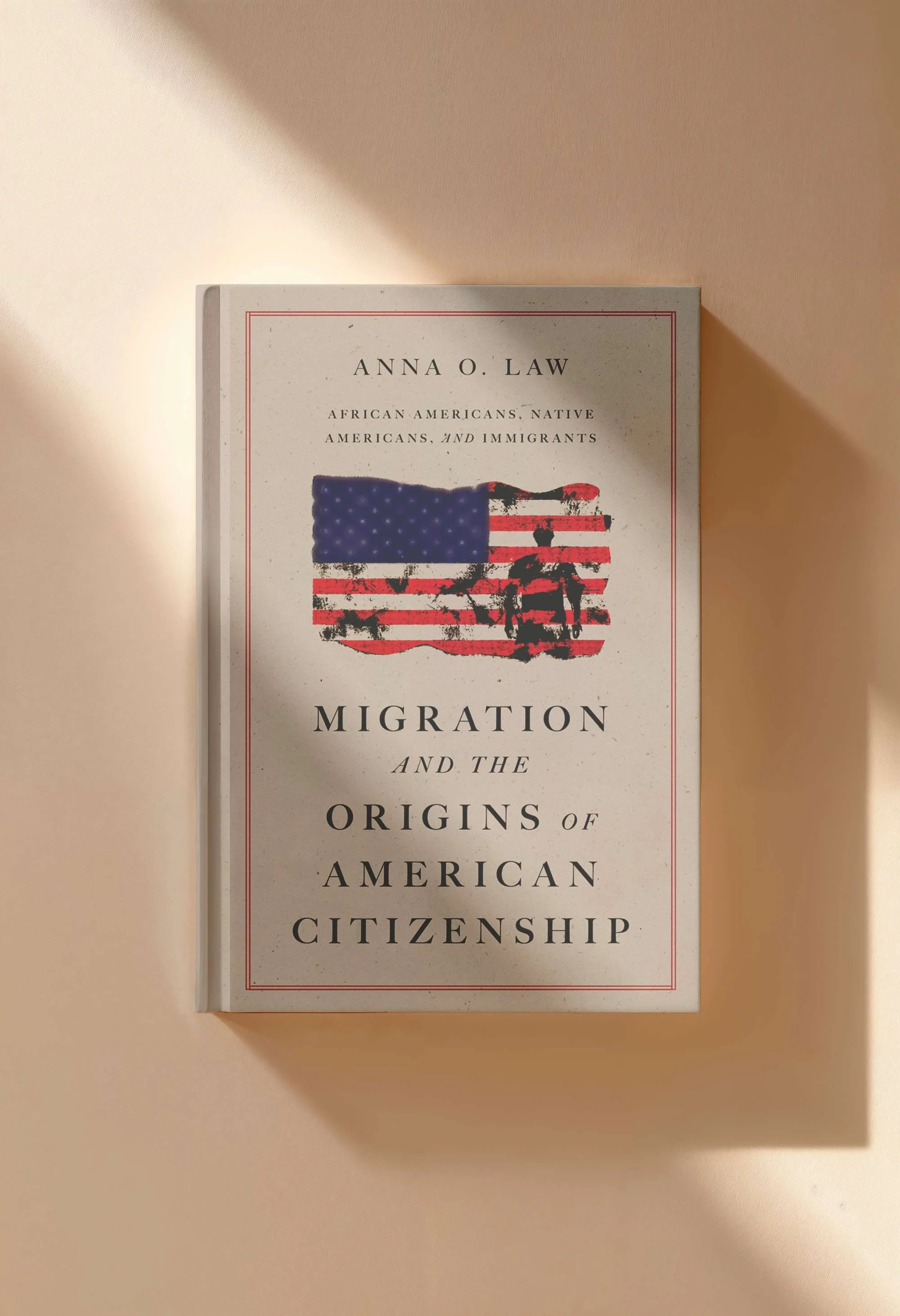
My research focuses on U.S. constitutional law, federal courts, federalism, and U.S. immigration policy and legal history.
Below are my current and recent projects:
Federalism in U.S. Antebellum Migration and Citizenship
In Migration and the Origins of American Citizenship with Oxford University Press was published in March 2026, I answer the question: In a system where states and the federal government share power, which level of government, the national or colony/state, had control of of migration and citizenship policies and why?
Dating back to the colonial period, the power sharing arrangement between the English metropole and its satellite North American colonies was one in which the colonies primarily managed migration policy. Citizenship during this long period remained nebulous in two ways: what rights were included in national and state citizenships was undefined, and the hierarchical relationship between national and state citizenship was little understood. That pattern and practice of local control of migration and citizenship continued through the early republic and until the last quarter of the nineteenth century, a period of over a century when these these laws and policies were managed by states. Migration policy began federalizing in 1882, the year when the federal Chinese Exclusion Act was passed.
That there was no national control over migration policies until 1882 did not mean that in the colonial, early republic, and antebellum international and intrastate borders were open. The politics of each era left politically disfavored classes of people to navigate a patchwork of state and local laws restricting their mobility internationally and domestically. Related sets of laws also impeded their ability to remain in the place of their choosing. Poor, sickly, disabled, criminal and free Black people discovered that local control over migration multiplied the types of restrictions on their freedom of movement and ability to remain. While these groups were subject to state migration laws, the national government retained authority to manage where Native people could stay through that period and until the present. The U.S. federal system and the politics of the times determined the nature and scale of the government power arrayed against all these groups, some who wanted to be mobile, and Native people who wished to stay on their ancestral lands.
Central to the determining the location of the dividing line between national and sub-national authority over migration and citizenship policies in the antebellum period was the institution of slavery and Native dispossession. For too long U.S. immigration policy history, African American and Native American histories have been read separately. Slavery, rather than just an economic system or an institution of social control was an institution that shaped and circumscribed many other aspects of American life and politics, including voluntary migration law. Native Americans, who are not migrants at all as the original inhabitants and owners of the land, have a distinct relationship to the land and the US polity than voluntary and involuntary migrants. The dispossession of Indigenous people fueled the wealth of the US and families of European descent who the federal government gave subsidized “public lands” to. Thus, lawmakers saw the ability of Native people to stay as zero-sum in relation to European settlement.
I’ve published portions of three chapters as stand alone articles:
“The Civil War and Reconstruction Amendments’ Effects on Citizenship and Migration.” Journal of American Constitutional History, 3 (1): 111-138 (February 2025)
“The Historical Amnesia of American Immigration Federalism.”Polity, 47 (2): 302–19 (July 2015).
“Lunatics, Idiots, Paupers, and Negro Seamen: Immigration Federalism and the Early American State.”Studies in American Political Development 28(2): 107–128 (October 2014).
Gender-Based Asylum in the Immigration Court
Under a National Science Foundation collaborative research grant with Karen Musalo of University of California Hastings College of the Law, we are answering the question: How do U.S. immigration courts decide gender-based asylum cases? For this project, we are analyzing hundreds of immigration agency administrative decisions and creating two original data sets that we will analyze both quantitatively and qualitatively to assess which factors affect legal outcomes.
This collaborative study focuses on the decision making processes in the evolving field of gender-based asylum law. It is especially timely because the legal definition of “refugee” and “asylee” does not explicitly designate gender as a ground for protection making gender-based claims fraught. We will undertake a study of the largest known repository of immigration courts and Board of Immigration Appeals asylum decisions from around the country (more than 760 decisions) and supplement those with decisions obtained through FOIA requests. These will be coded and turned into two original data sets that systematically tracks the characteristics of the adjudicators and asylum claimants as well as case fact patterns. Because administrative opinions on asylum are not available to the public, this unique study will examine a level of immigration bureaucracy never before studied in this regard.
Our team published the first article from our research:
“With Fear, Favor, and Flawed Analysis: Decision Making in US Immigration Courts.” Boston College Law Review, 65 (8): 2743-2800 (Fall 2024)
The Immigration Battle in American Courts
In my first book, The Immigration Battle in American Courts (Cambridge University Press: Hardcover 2010, Paperback 2014), I examine the role of the Supreme Court and the U.S. Courts of Appeals—the two highest federal appellate courts—in U.S. immigration policy.
Immigrants have a better chance of winning their cases at the U.S. Courts of Appeals rather than the Supreme Court. This situation is not due to any Supreme Court xenophobia or racial animus against immigrants, but due to each court’s institutional setting. Just as one would behave differently at a funeral than at a wedding, the distinct institutional settings of the two highest federal courts affects the way these judges and justices approach their job.
Over time, the courts have diverged in mission and function. While the Courts of Appeals retained its function of looking for mistakes made by the trial court, the Supreme Court, based on its ability to select what cases it hears, has turned into a policy court. Immigrants have a better chance of winning when a court examines and weighs their claim individually in the approach taken by the U.S. Courts of Appeals. They tend to lose when a court views them as representative of a class of similarly situated individuals, the approach favored by the Supreme Court.
Book reviews:

“Professor Law employs both an expertise in political science and a robust understanding of legal analysis to illuminate the impact these extrajudicial institutional factors have on the ultimate merits decision of a case.”