“Analytically rich.”
“Timely, fascinating, and meticulous.”
“Rich, compelling, and authoritative.”
“Comprehensive, illuminating, up to date in numerous fields.”
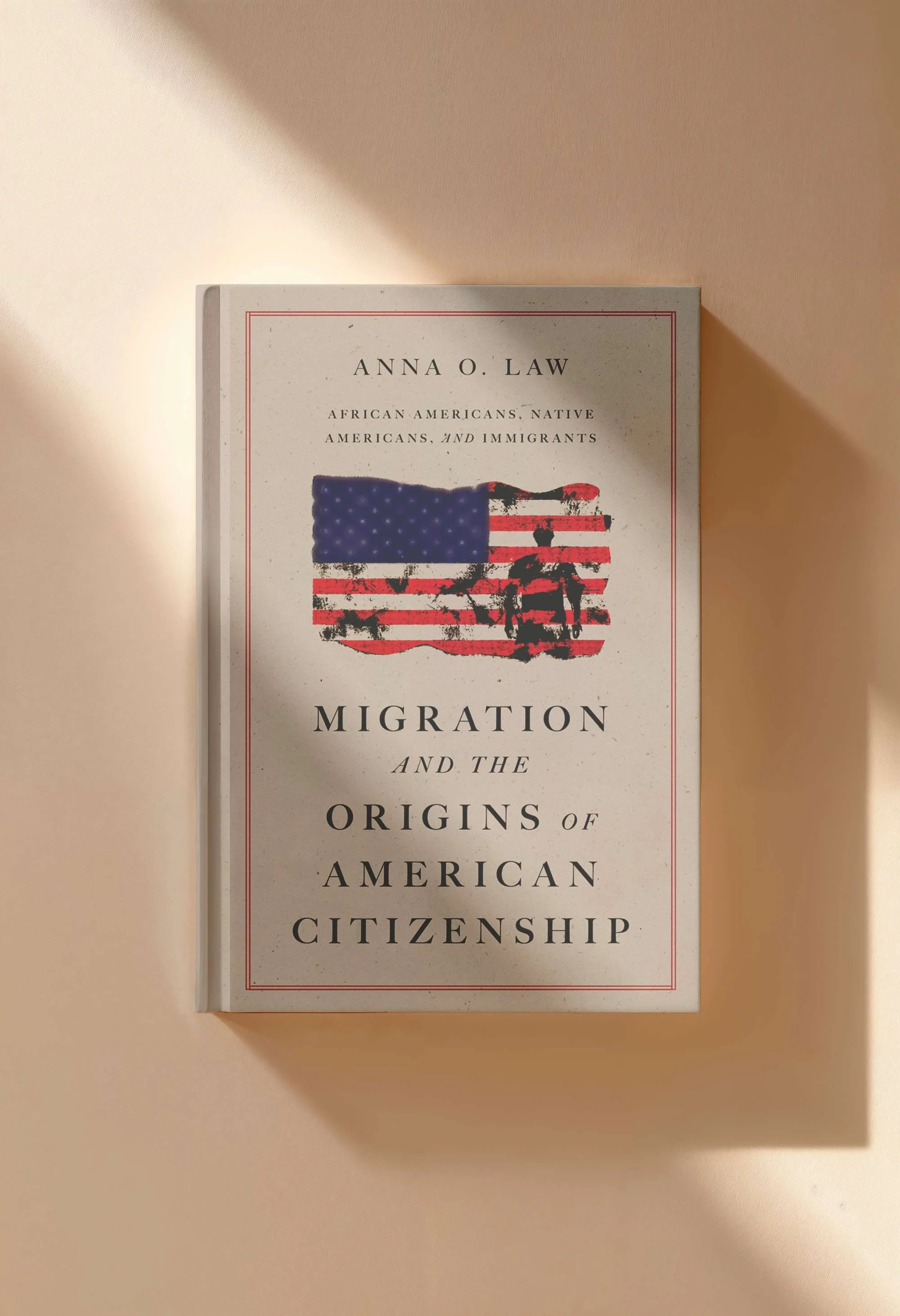
About Migration and the Origins of American Citizenship
Since the late nineteenth century, the U.S. federal government has enjoyed exclusive authority to decide whether someone has the ability to enter and stay in U.S. territory. But freedom of movement was not guaranteed in the British colonies or early U.S. By contrast, voluntary migrants were met with a crazy quilt of laws and policies created by colonies and states, which denied free mobility and settlement in their territories to unwanted populations.
Migration and the Origins of American Citizenship presents a story of constitutional development that traces the confluence of the logics of slavery and settler colonialism in historical legal rulings and public policy about migration and citizenship. The book examines the division of labor between the national and state governments that endured for over a century, reasons why that arrangement changed in the late nineteenth century, and what the transformation meant for people subject to those regimes of control. Drawing into one study the migration policy histories of groups of people that are usually studied separately, and combining the methodologies of political science, history, and law, Anna O. Law reveals the unmistakable effects of slavery and Native American dispossession in modern U.S. immigration policy.
Buy the book:
Praise for the Book
“The best works of history and political analysis show us that what was once invisible or taken for granted has had a history and a structure.”
—David Waldstreicher, CUNY Graduate Center and author of Slavery's Constitution: From Revolution to Ratification
“Timely, fascinating, and meticulous. Professor Anna Law has excavated a history of immigration and migration that is as well known to marginalized populations as unknown to contemporary scholarship.”
—Mark Graber, Regents Professor, University of Maryland, Francis King Carey School of Law
“Refreshingly free of academic jargon and analytically rich, Migration and the Origins of American Citizenship exposes the long history of contested politics over migration and the crucial precursors for today’s debates about immigration policy.”
—Lucy E. Salyer,
University of New Hampshire
“Among the most basic elements of membership and belonging is the right to move freely and to set down roots, yet Professor Law masterfully chronicles how elusive these rights were for nearly everyone but European immigrants and their descendants in colonial and 19th-century America.”
—Daniel J. Tichenor, Philip H. Knight Chair of Social Science, University of Oregon
Where to buy the book:

About Anna O. Law
Anna O. Law is the Herbert Kurz Chair in Constitutional Rights at Brooklyn College. Although trained as a political scientist, Law’s research and writing, illustrated in Migration and the Origins of American Citizenship, span the disciplines of political science, history, and law.
Book Events
→
Book Events →
Recent & Upcoming Book Talks and Media Appearances
-Amicus podcast with Dahlia Lithwick, March 14
-Mark Twain House, June 25
-Reddit AMA AskHistorians, June 26
-University of Texas, Austin, Sept 10
-Notre Dame University, Sept 21
Q&A with Anna O. Law
Q: Why did you write this book?
AOL: A question I didn’t have the answer to even after surveying a lot of scholarship nagged at me for years: “What is the relationship of slavery and forced migration to voluntary migration?” I set out to find the answer but didn’t know when I started that it would take 16 years to uncover and then present it in a way that others could comprehend what I found.
I also realized that different groups of people have distinct relationships to the land and the US polity. Native Americans have a unique relationship to both. The often heard claim that the border was “open” before the late 19th century does not explain how distinct classes of people arrived under very different legal and political contexts, such as voluntary migrants versus enslaved captives.
Q: What do we learn by putting African Americans, Native Americans, and immigrants in the same study?
AOL: Only by putting all these groups together can we understand how the legislators, jurists, and general public of different eras of US history believed that the ability of some groups, namely Native Americans, to stay on their ancestral lands, was relational to white settlers’ desire to own that same land. Several Supreme Court cases from the nineteenth century mentioned these seemingly disparate groups of people in the same legal opinions.
Nineteenth-century lawmakers and the public alike also viewed the ability of groups to remain where they wanted to as zero sum. Native Americans are not migrants because they are the original occupants and owners of lands where they lived for generations before settler arrivals. But Americans dispossessed Native Americans of their land, sometimes by force or treachery, including through the violent mass deportations of 80,000 Native people in the 1830s. What was Native land was re-labeled as “public land” that the U.S. government sold at subsidized rates to European voluntary migrant families and to incentivize overseas Europeans to migrate.
Q: Why do slavery and voluntary migration belong in the same conversation? Is slavery immigration?
AOL: Putting slavery and immigration together seems wrong because of the evil and violence at many levels that institution embodies. Most U.S. immigration historians and US immigration law professors do not study slavery with voluntary migration for very good reasons. Slavery is set aside because of the totally involuntary nature of the migration and labor of enslaved people. Slavery absolutely is not “immigration” because that term implies consent. The institution is, however, migration. And, the forced migration of African and African American people affected the content and trajectory of laws and policies on voluntary migrants.
When the 1619 Project essays came out about halfway through my preparation of my book, I knew I was on to something. It is inconceivable that the institution of slavery, which shaped so many aspects of American life, would have had no influence on voluntary migration policy and law. I had been aiming to publish my book in 2019, which marked the 400th anniversary of the first arrival of enslaved people in the colonies. I missed that date, but the publication of those influential essays made it easier for me to explain to others what I was trying to do with Migration and the Origins of American Citizenship, which is to trace the effect of slavery into policy areas and bodies of law that seemed to have nothing to do with slavery.
Q: How does this history-focused book help us understand the current fights over immigration?
AOL: I have been told by many friends and acquaintances that Migration and the Origins of American Citizenship is very “timely.” I am horrified. No one who wrote a book about slavery, Native American dispossession, and Chinese exclusion wants to be relevant to current politics. Evidence of the book’s relevance is that the Chinese American Legal Defense Alliance cited the book in their amicus brief arguing for preserving birthright citizenship in the Supreme Court case, Trump v Barbara decided in June 2026.
One of the main themes of Migration and the Origins of American Citizenship is federalism. The U.S. has a federal system of government in which the national, state, and local governments share power. But since the Constitution’s text does not say which level of government controls immigration (except to say Congress controls naturalization, only a narrow aspect of migration), the location of the line dividing national and state control over migration has been determined by the politics of every era. This book helps us understand where the line was and the consequences of whether the federal or state governments manage aspects of migration.
Q: What classes do you envision engaging with your book?
AOL: I can see undergraduate and graduate Race and Ethnicity and U.S. immigration policy classes using the book to understand the legal status in which people arrived and how these decided their access to legal rights and privileges. And Intro to American Government classes might use select chapters to illustrate the power of the federal system in shaping U.S. politics.
Legal history classes might use this book to convey the point that when legal doctrines (like state police powers and plenary power) appear and how long they last in influence are politically and historically determined. Lines of precedent do not evolve by being sealed off from the world; these doctrines emerge, rise, and fall based on the historic and political contexts they are nested in.
Finally, I went out of my way to write accessibly by eschewing jargon. With immigration being front and center in the news, and with the Supreme Court deciding a case on the constitutionality of Trump’s Executive Order abolishing birthright citizenship, concerned citizens and curious laypeople might want to know some of the historical context and background of U.S. immigration law.
