My Writing Process
Yesterday, legal historian Karen Tani asked other historians on BlueSky what tech they used to organize their notes, bibliographical sources, and evidence. She was asking about one’s writing process, essentially how academic books and articles are created. I responded to her post with this picture of the low tech notebooks and reusable book dart bookmarks I used to write my recent book.
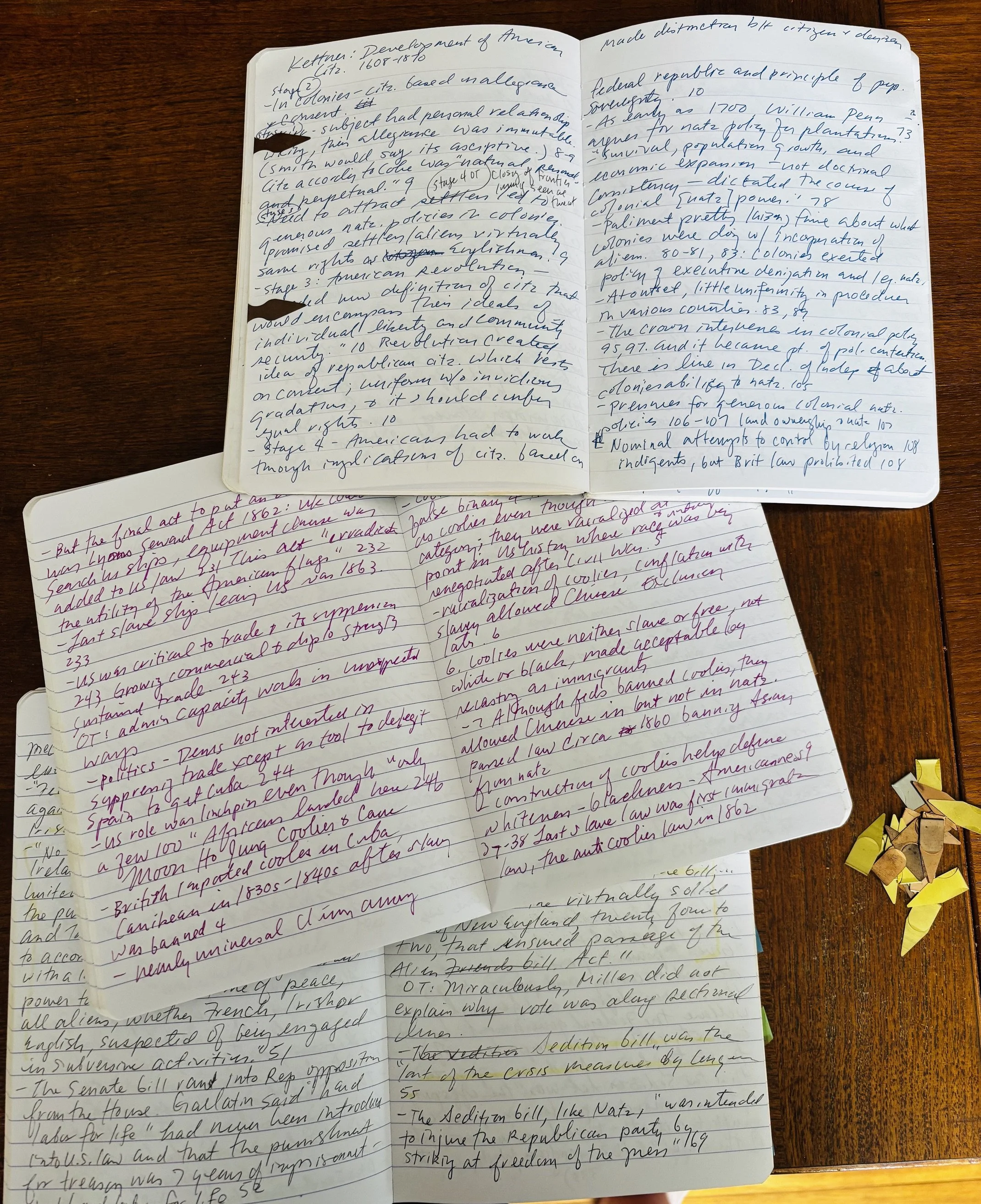
Three open notebooks filled with handwritten notes and a pile of copper reusable book dart bookmarks
Migration and the Origins of American Citizenship was a synthesis, a weaving together of my reading of other scholar’s monographs, local and federal laws, and journal articles. That synthesis included primary sources like founding documents and congressional floor debate records from 1798. I read many, many, many books and articles to simply understand the time periods and to lay down basic information. How did I organize all that data?
Over the 16 years it took to research and write Migration and the Origins of American Citizenship, I filled more than 5 notebooks with handwritten notes. After I read a book or article, to properly digest and distill, I turned to my notebook. These were not just summaries. I flagged passages I wanted to cite later with the page numbers from the source. I asked questions of myself about things I had yet not figured out. Questions were marked like this “Q: what is the connection between Native Americans’ presence and voluntary migration? Why are Indigenous people in a book about voluntary migration? Needs explanation.”
My notes included connections I had made in reading something. “OT” was shorthand for “Original Thought!” also known as my Aha! moments. Here’s an example, “OT: it didn’t matter that border states couldn’t inspect/apprehend every free Black person who wanted to stay b/c they lacked the personnel. Laws on the books were to provide pretext for surveilling and harassing all Black people.”
And so it went, across 16 years. Guess what this process does NOT describe? AI, which is artificial, but not intelligent and unable to formulate connections between ideas and across sources. It can only mindlessly mash text together.
For more about Migration and the Origins of American Citizenship, see here.